
2026-04-30 08:34:56Tech Orange
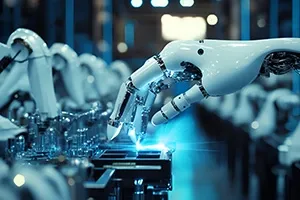
The evolution and impact of physical AI are reshaping global manufacturing at an astonishing pace. At the "AI Robotics Industry Forum" recently held (April 14th) by TechOrange, NVIDIA, and Foxconn Technology Group, TechOrange President Tai Chi-Chuan cited practical data shared by Foxconn Chairman Liu Yang-Wei at the U.S. Capitol and Silicon Valley forums, pointing out that "in the past, a production line typically required 30 to 40 people to operate, but after implementing AI and automation technologies, it now only requires about 5 people." This demonstrates that AI robots are operating in smart factories at an extremely rapid pace of evolution.
Regarding the specific implementation of this new industrial revolution, Kuo Liu-tsung, General Manager of the Robotics Division of Foxconn Technology Group, delivered a presentation titled "Building and Scaling AI Factories With Digital Twins and Robotics," analyzing how to utilize digital twin and robotics technologies to construct and scale AI-native factories. Kuo pointed out that Foxconn, in collaboration with NVIDIA, combined digital twin and robotics technologies to build an AI factory in the United States that produces GPU servers, demonstrating its ability to integrate virtual and physical production from simulation to physical manufacturing.
From digital twins to AI decision-making: Four steps to build an integrated, AI-native factory.
Kuo Liu-tsung pointed out that building a smart factory requires implementing four key steps. The first step is to "establish a digital model," which means creating a digital twin environment for the factory, converting the factory structure and various production equipment into standard 3D digital files at a 1:1 scale, and building a digital factory in the virtual world.
The second step is "precise simulation." Before the physical equipment arrives on-site, it is tested in a virtual environment to avoid the enormous costs associated with repeated trial and error in a real factory. Guo Liuzong particularly emphasized two key points in the simulation phase. The first is high-level server thermal flow simulation (CFD). Because AI servers have extremely high computing demands, they consume a lot of power and generate extremely high temperatures during test operations. When the power consumption of a single rack reaches 1 MW, it is necessary to simulate and plan the factory's thermal flow through digital simulation. The second is the simulation of robots and logistics flow. Guo Liuzong used a US factory as an example. In order to achieve the highest efficiency in loading and unloading 12 server test racks, five different types of robots were tested through a detailed physical model (URDF). The efficiency of logistics vehicles such as CTU and RGV was compared to identify operational bottlenecks in advance and eliminate the risk of "traffic jams."
The third step is to "import physical data into the virtual world." This involves integrating and connecting IoT device data, manufacturing operations management systems, and standard operating procedures from the physical factory with the NVIDIA Omniverse platform.
Finally, we move on to the fourth step, "Importing AI Analysis," which gives the factory transparency and real-time responsiveness, and proactively provides troubleshooting suggestions before equipment failures occur. Kuo Liu-tsung said that the factory has a highly transparent real-time war room where all data is real-time, allowing them to grasp the factory's production progress immediately.
Through the integration of virtual and physical AI factories, the manufacturing process is no longer just about assembling hardware, but is transformed into a smart ecosystem that can be scheduled in real time, replicated quickly, and has self-diagnostic capabilities, thus achieving agile production and large-scale transformation.
Defining a new level of flexible manufacturing: Building an AI robot production line that "gets smarter the more it's made".
In the architecture of an AI factory, the deployment of physical robots is the core key to achieving "flexible manufacturing." "In the past, factories using complete sets of automated equipment might face the fate of being scrapped entirely, but humanoid robots will not be affected," said Guo Liuzong. The biggest advantage of introducing humanoid robots into an AI factory lies in their high flexibility and adaptability to production. After the robots are deployed on the production line, they only need to be equipped with suitable hand tools, and the "skill models" required for the corresponding workstations can be downloaded in real time from the edge server to directly switch tasks. This highly flexible operating mechanism not only breaks the limits of traditional automated equipment, but also allows smart factories to easily cope with rapidly changing product demands.
Once the robots are officially operating on the production line, the system will record all the operational details, forming a continuously optimized data flywheel. Through this closed-loop system, the entire factory will become "smarter and smarter" with the accumulation of time and data, showcasing a super-automated smart factory that combines digital twins and flexible manufacturing.
Declare:The sources of contents are from Internet,Please『 Contact Us 』 immediately if any infringement caused