2026-05-29 11:00:51vocus

I've always wanted to share the framework of this scientific research report, which gave me a deeper understanding of "circular economy" and "sustainability".
This framework is not only applicable to industrial transformation, but also to our individual consumption decisions. Let's rethink together: what truly constitutes "more environmentally friendly" consumption?
As the public begins to value environmentally friendly products, terms like "sustainable," "green," and "environmentally friendly" are being overused in marketing and advertising, even sparking controversy over "greenwashing." Among the many solutions, the "circular economy" has been widely recognized as one of the key keys to solving the environmental dilemma over the past decade. However, this is contingent on having a correct understanding of it.
This is the officially released report, "Circular Economy: Measuring innovation in the product chain," following a collaborative assessment of the Netherlands' circular economy policies by the Dutch Environmental Assessment Agency (PBL) and Utrecht University. It proposes a more comprehensive "10R framework" than the traditional 3R framework. This article will provide a clear and concise explanation of this framework, helping you move from simply "knowing" to "doing."
Since 10R is rarely mentioned in Chinese-language content, this article aims to provide a simple yet in-depth introduction to this framework and the reflections it can bring to consumers, helping us to rethink: what constitutes a "more environmentally friendly" or "more sustainable" consumption habit?
What is the "circular economy"? It breaks away from the mindset of a linear economy.
To understand the circular economy, we must first understand its differences from the traditional economic model:
Linear Economy: Resource extraction → Product manufacturing → Consumption → Disposal (landfill or incineration) . This is the mainstream model, but it leads to resource depletion and waste accumulation.
The circular economy utilizes restorative and regenerative design to ensure that products and materials maintain their highest value throughout the system. Simply put, it aims to preserve the effectiveness and value of a product or service for as long as possible throughout the entire process .
Simply put, the ultimate goal of the circular economy is "no waste." In an ideal circular society, trash is gold, and everything can be recycled in some form.

Comparison chart of linear economy and circular economy (Source: PBL, 2016)
Is resource recycling the same as the circular economy? This is a common misconception.
Many people intuitively believe that "doing a good job of recycling resources" is the same as the circular economy. Yes, but not entirely.
In a waste hierarchy, "recycling" is only slightly better than "discarding." It's often an easier goal to achieve (low-hanging fruit), but recycling alone isn't enough. We need more valuable recycling methods.
The "circular economy" can be simply imagined as the "ideal sustainable world," because in a 100% circular society, there is no such thing as waste; everything can be recycled in some form within the system.
The "10R" cycle strategy proposed by Dutch research
The report outlines 10 strategies (R0-R9). The lower the number, the higher the circularity and the better for the environment. The traditional 3Rs are actually included, but in a more backward order.
As for what methods are available? This report has compiled ten methods, some of which you and I should be familiar with (of course, whether or not we can actually do them is another matter).
The strategies with the greatest sustainable value (R0-R2)
R0 Refuse: Directly refuse to buy unnecessary products. This is the highest level.
R1 Rethink: Make products more intensively used (e.g., shared products, multifunctional designs).
R2 Reduce: Improve manufacturing or usage efficiency and reduce resource consumption.
Strategies to extend product lifespan (R3-R7)
R3 Reuse: Receiving a discarded but still functional product from someone else and continuing to use it.
R4 Repair: Repairing damaged products to maintain their original functionality.
R5 Refurbish: Organize and update old products.
R6 Remanufacture: Using components from an old product, a completely new product with the same functionality is manufactured.
R7 Repurpose: Repurpose old product parts for use in new products with different functions (e.g., turning waste tires into backpacks).
Last resort (R8-R9)
R8 Recycle: Recycle materials by downgrading them through processing.
R9 Recover: Energy recovery through incineration of materials.

Dutch PBL 10R Cyclic Strategy Pyramid (Source: PBL, 2016)
These 10 strategies are not unrelated; if you place them within the entire product manufacturing process, their interrelationships become clear:
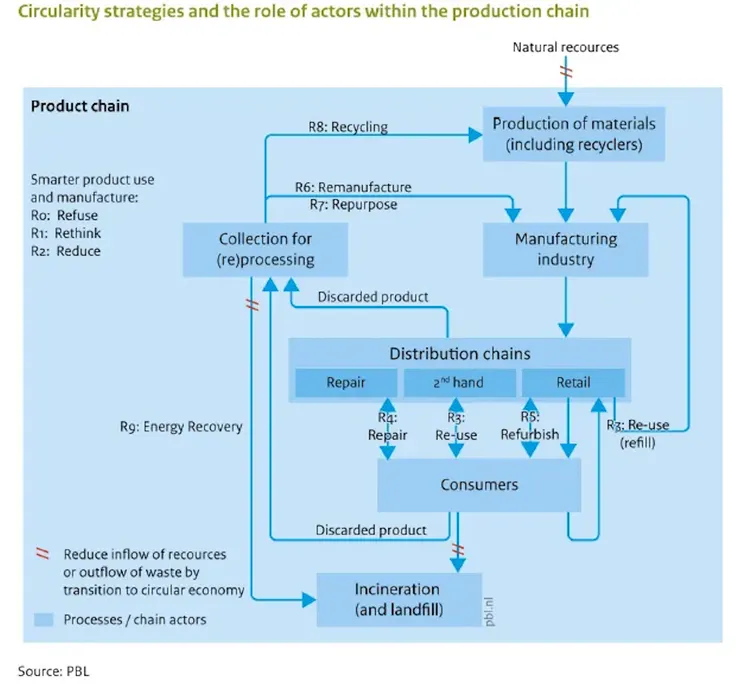
Association diagram of the Dutch PBL 10R cyclic strategy (Source: PBL, 2016)
Circular Economy Living Practices: Starting with These 3 Habits
Returning to the core question: What constitutes a "more sustainable" consumption habit? Besides bringing your own reusable cup and recycling, this report gave me three profound reflections on life and habits to cultivate:
1. Pre-shopping self-talk: Practice "Refuse" and "Rethink"
The most environmentally friendly way to consume is not to consume at all. However, achieving 100% zero waste is extremely difficult. What we can do is "conscious consumption." When I want to shop, I ask myself the following questions to prolong my thought process and avoid impulsive purchases:
Do I "need" or "want"? What are the underlying reasons?
What "features" do I need?
Do I already own an item with "similar functionality"?
This process made me realize that often I want to buy things simply to fill a void of security or to demonstrate some kind of value, rather than because I actually need the item. Once I figured out the root cause, the problem often could be solved without spending money.
2. Embrace the "sharing economy": Enjoy the right to use, not the right to own.
From Airbnb and Uber to Ubike, the sharing economy is essentially a digital manifestation of a "friendly and neighborly" spirit. Cultivating this habit requires overcoming a psychological hurdle: "I don't necessarily need to own it, but I can enjoy its services." If we pursue the "benefits" that items bring (e.g., mobility, accommodation, repair tools), then ownership is no longer a necessary condition. Renting or sharing not only reduces resource waste but also saves us the effort and space of maintaining items, allowing us to focus on more valuable things.
3. Cultivate patience: Be willing to "repair" and wait.
In this fast-paced era, patience has become a rare virtue. When something breaks, we're used to buying a new one immediately (because repair shops are hard to find and expensive), skipping the R4-R7 repair stage. Online shopping's one-click ordering also allows us to skip the process of "rejection" and "thinking." Learning patience—being willing to spend time repairing an item, or being willing to wait instead of immediately satisfying desires—is the greatest challenge, and also the greatest growth, for modern people cultivating a cyclical lifestyle.
Conclusion: Value is more important than price, and happiness is more important than pleasure.
The circular economy does not mean that we should go back to the days of poverty in the past, but rather remind us whether our minds have kept pace with our material progress.
Through practicing these habits, I have come to a profound realization:
Value is more important than price
Time is more important than money
Happiness is more important than pleasure
The most valuable investments in life should be experiences, learning, relationships, and assets, not consumable products. Only when we are no longer bound by "owning" and "consuming," and no longer use material things to fill the void, can we live freely and comfortably, and have a truly abundant and sustainable life.
Declare:The sources of contents are from Internet,Please『 Contact Us 』 immediately if any infringement caused